Abstract
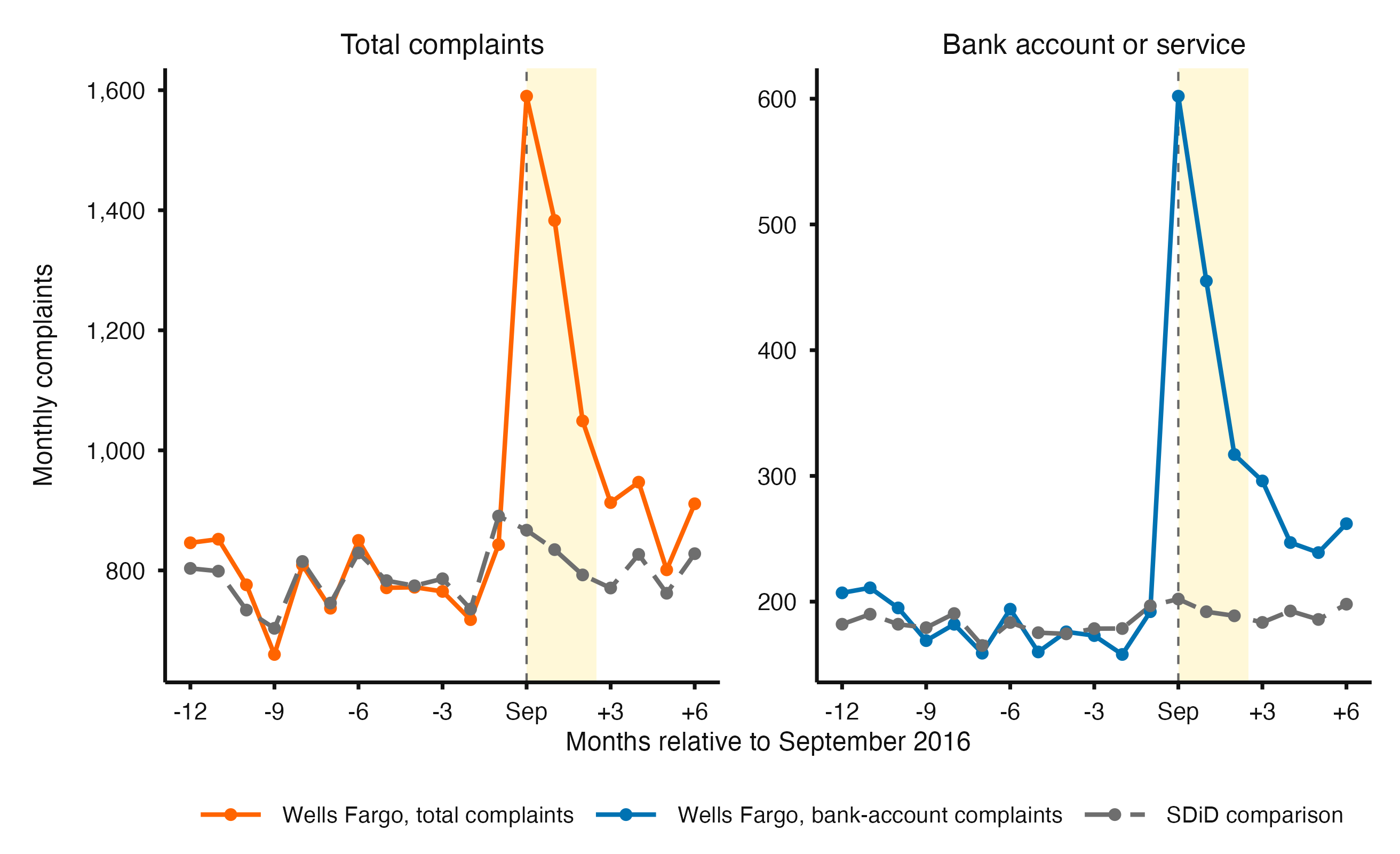
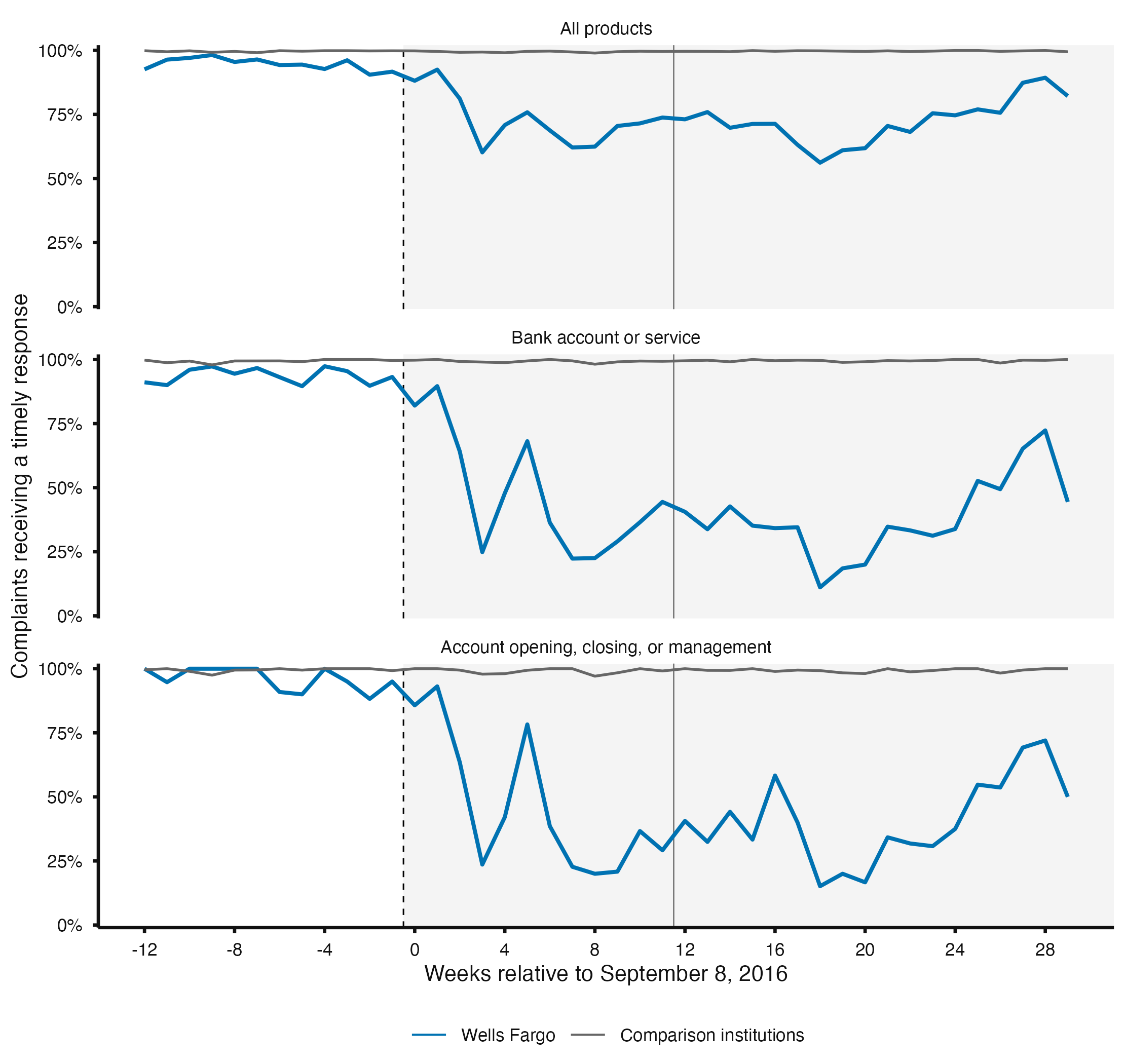
We show that consumers file more formal complaints after—rather than before—public enforcement actions by the Consumer Financial Protection Bureau (CFPB). Using synthetic difference-in-differences, we study the filing response to Wells Fargo’s September 2016 enforcement disclosure action. We estimate that monthly complaints rose by 70.6% of Wells Fargo’s pre-disclosure average over the following three months. The increase initially spanned products but persisted in the category most closely tied to the conduct described in the action. In that category, the complaint increase is accompanied by a 35.0-percentage-point deterioration in Wells Fargo’s relative timely-response performance. We extend our analysis to the first eligible CFPB action at each of 19 financial institutions using a category-matched staggered difference-in-differences design. We estimate a 40.8% increase in named-product complaints during the four weeks relative to the same categories at never-treated institutions. Together, the results show that public enforcement actions change which customer problems enter regulator-managed processes as formal complaints and that, at Wells Fargo, the disclosure action coincides with weaker monitored response performance.
Monthly Wells Fargo complaints and the SDiD comparison path
Weekly timely response after complaints reach the company
Complaints increase in the categories named by CFPB actions
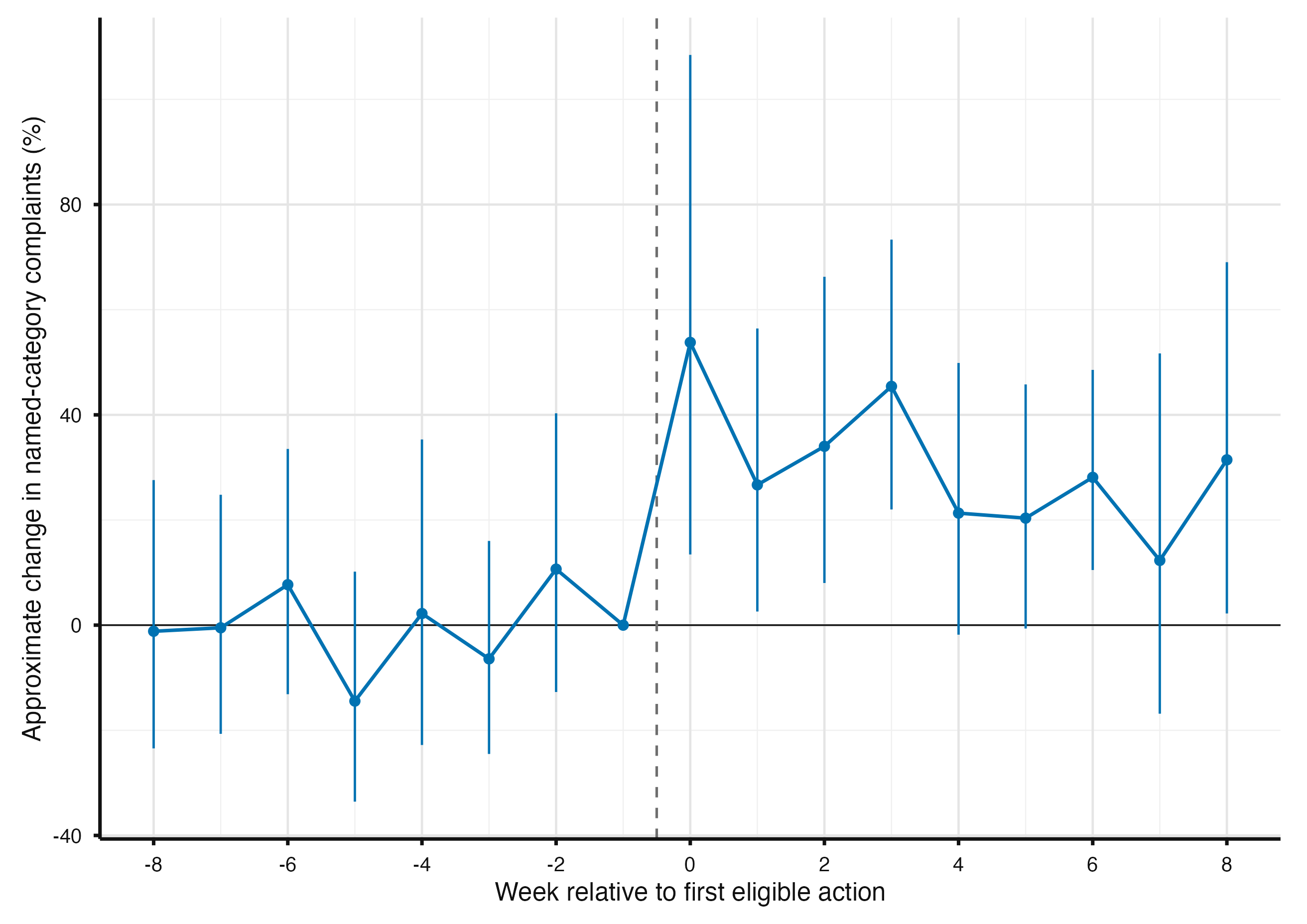
The figure compares 19 treated institutions with 58 never-treated institutions, using complaints in the categories named by each action.
Citation
Osman, Syed Muhammad Ishraque, and Nicholas R. Pusateri. 2026. “To File or Not to File: Consumer Complaints After CFPB Enforcement Actions.” Working Paper. URL: https://www.nicpusateri.com/tfontf.
@article{osman2026file,
  title={To File or Not to File: Consumer Complaints After CFPB Enforcement Actions},
  author={Osman, Syed Muhammad Ishraque and Pusateri, Nicholas R.},
  journal={Working Paper},
  year={2026},
  url={https://www.nicpusateri.com/tfontf},
  }